Web Performance for SMEs: Why Page Speed & User Experience Drive Business Results
How companies turn their website from a digital business card into a measurable growth tool
Many SMEs eventually reach the same point:
The website is online, it “works fairly well,” but it doesn’t really deliver results. There are no consistent inquiries, little measurable success – and above all, the feeling of always being a step behind technically.
This is where the topic of web performance begins. And with it the question of why page speed today is far more than a technical detail or a pure SEO topic.
Page speed is not a technical gimmick – it is an economic lever
The loading time of a website has a direct impact on how users perceive your brand. A slow website appears unreliable, unprofessional and, in the worst case, frustrating. This usually happens subconsciously – but with clear consequences:
- Visitors leave earlier
- Content is perceived less
- Inquiries and purchases fail to materialize
Regardless of industry or company size, the following applies today:
The faster a website responds, the higher the probability that visitors turn into customers.
Google no longer evaluates website performance using only technical load time metrics. Instead, it combines technical performance data with real user experience signals.
The foundation of this approach is Core Web Vitals, a set of standardized metrics that measure how real users experience a website in terms of Loading speed, Interactivity & visual stability.
Reports commissioned by Google confirm that loading speed, interactivity and visual stability can have a direct impact on revenue associated with a website – and together determine how “good” a website feels. It is precisely this feeling that builds or undermines trust.
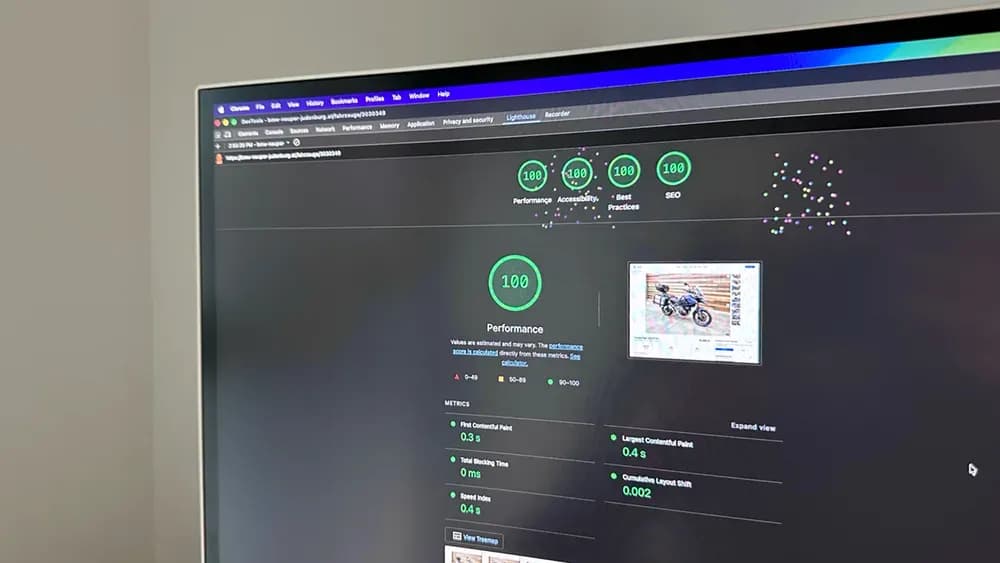
If you would like to independently evaluate your own website, we recommend using Google PageSpeed Insights. Enter the page you want to test and click “Analyze.” After a short time, your website will be rated across several categories on a scale from 0 to 100.
Is your website a black box?
Many companies invest in design, content and campaigns – yet do not know what actually happens on their website. Are you familiar with your analytics data? Do you know how many visitors land on your site and leave again without a single interaction?
This is where bounce rate comes into play. It describes cases in which a person visits your website and leaves immediately – without a click, without a form submission, without a purchase. Every bounce represents lost attention, unused potential and ultimately lost revenue.
If these figures are already available to you, the next step is obvious: analyzing bounces correctly. Where do users drop off? Is it related to loading times, content or user flow? We are happy to support you in making these relationships visible and optimizing them based on data – so that visitors become contacts, leads or customers.
If you are not yet familiar with your key metrics, this is not a disadvantage but an opportunity. Without a clean analytics setup, your website remains a black box. We help you implement the right tracking and analysis tools to enable well-founded decisions.
The result:
- better loading times
- clearer user guidance
- lower bounce rates
- more inquiries, leads and conversions
In short: you understand what is happening on your website – and can improve what matters in a targeted way.
What you can do yourself in the short term – and where support makes sense
Not every optimization requires a major project right away. Some steps can be taken independently to achieve initial improvements:
- Regularly check the loading speed of your key pages (homepage, service pages, contact form)
- Reduce unnecessary elements such as large images or outdated plugins
- Review tools, tracking scripts and external services: are they all really needed?
- Analyze basic metrics such as bounce rate and time on page
These measures create initial awareness, but they do not replace structured optimization.
Many performance issues lie beneath the surface – in the interaction between technology, user guidance and content. When decisions are based on intuition, or optimizations “feel” ineffective, professional support becomes valuable.
Your website is not a digital business card – think bigger
Many SMEs still view their website as a digital business card: providing information, being reachable, maintaining presence.
That is no longer sufficient.
A website can automate, qualify and sell – around the clock. It can pre-filter inquiries, simplify processes, reduce internal workload and address the right customers in a targeted way, provided it is strategically designed and technically prepared.
Whether automated lead flows, smart forms, data-driven user guidance or integration with existing systems: modern websites are active digital tools, not static pages.
JKienzl supports you in unlocking this potential.
With tailored solutions that combine performance, user experience and automation – aligned with your actual business processes rather than trends or templates.